
"National Cloud + National Chip": How Did We Claim the No. 1 Spot in SPEC Global Benchmarks?
May 28, 2026
On May 23, the international authority on standard performance evaluation, SPEC, announced the latest SPEC Cloud IaaS 2018 test results. Powered by Phytium Tengyun S5000C-E processors, China Telecom's CTyun platform achieved a groundbreaking score of 168.2, setting a new world record and ranking first globally.
Behind this historic milestone stands a comprehensive, homegrown computing power ecosystem.
Phytium CPUs provide the core computing power; China Greatwall servers serve as the hardware foundation; CTyunOS delivers underlying system support; and CTyun's TeleCloudOS handles resource scheduling and cloud platform management. The deep synergy across these four layers is what propelled this platform to the top of the global rankings.
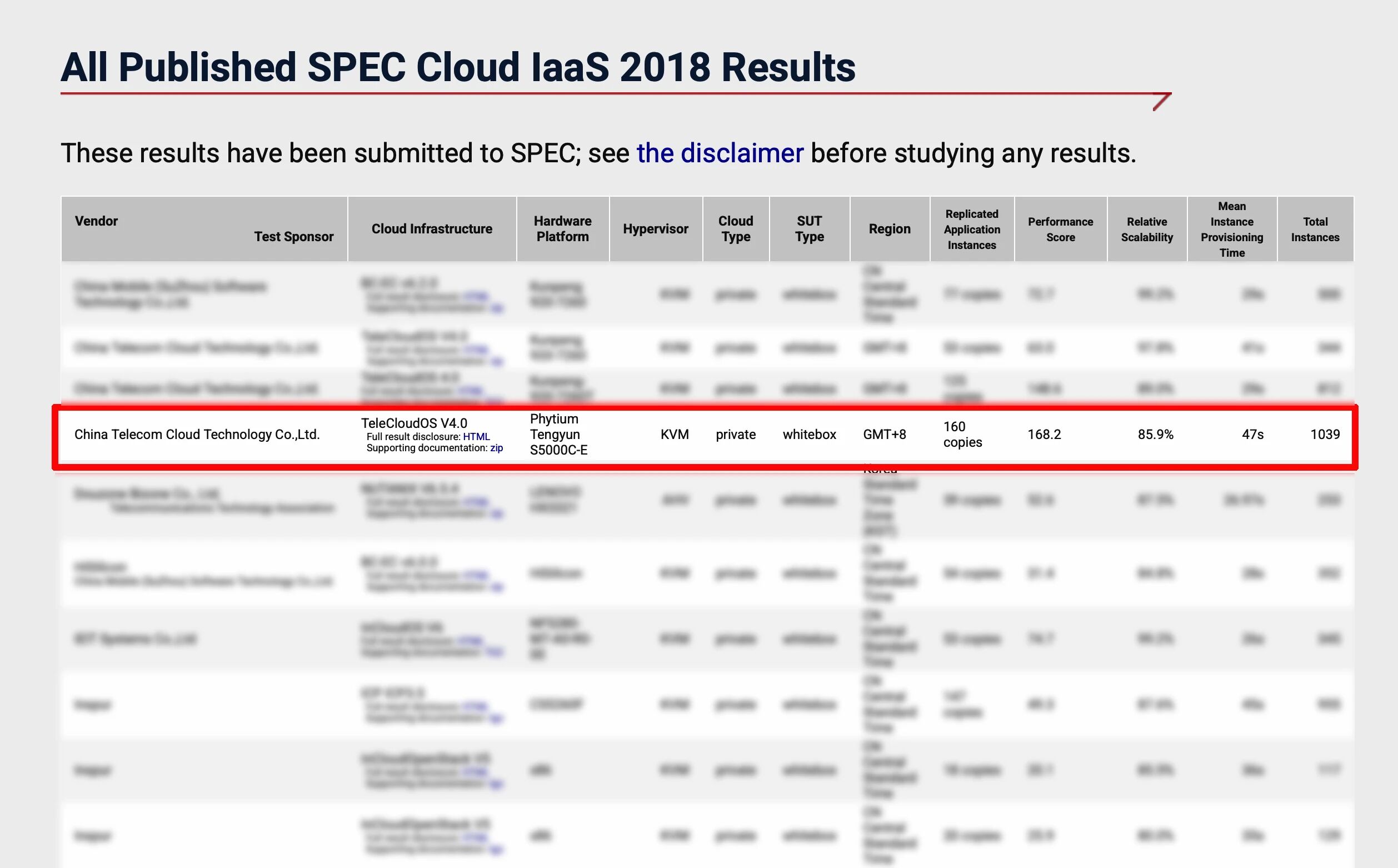
SPEC Cloud IaaS 2018 Test Results
This achievement also marks a new era for domestic computing power.
In the past, the industry's primary concern was whether localized tech was "usable." Today, the focus has shifted to a new phase defined by performance competition, system synergy, and large-scale deployment.
SPEC is widely recognized as one of the most critical performance standards in the global cloud computing sector.
What Exactly Does SPEC Measure?
The SPEC Cloud IaaS 2018 benchmark evaluates multiple dimensions, including:
·Resource scheduling under high concurrency
·Virtualization capabilities
·System stability
·Scalability
·Cloud platform management
·ICPU, memory, and I/O
While users interact with the cloud platform as a single entry point, a massive resource pool operates behind the scenes. Computing, networking, storage, scheduling, and virtualization all work simultaneously. A bottleneck at any single layer will drag down the overall performance.
Therefore, SPEC scores essentially measure the organizational capability of an entire cloud computing ecosystem.
In the AI era, this capability is becoming increasingly vital. Previously, many workloads could rely on single-point performance. Today, AI training, inference, Agents, and multi-model collaboration are continuously driving up system complexity. The competition for computing power is shifting from "single-point capability" to "system synergy."
Cloud Platform Performance Depends on the Entire Chain.
CPUs handle computing; servers provide stable hosting; operating systems manage resources; cloud platforms handle scheduling; and networks and I/O manage data throughput. Instability in any layer will cause the entire system to slow down. This has long been a challenge for domestic computing power.
Often, chip performance is already sufficient, but system synergy remains immature. Without deep adaptation between hardware, operating systems, and cloud platforms, resource scheduling efficiency, virtualization capabilities, and high-concurrency stability are inevitably compromised.
Benchmarks like SPEC Cloud are specifically designed to expose these issues. They continuously apply high loads, high concurrency, and prolonged runtime tests. What truly matters here is system-level engineering capability.
The fact that CTyun and Phytium topped the charts essentially proves that the domestic computing power ecosystem has successfully completed a comprehensive system synergy validation.
How "National Cloud + National Chip" Achieved Global No. 1
The core of this achievement lies in "full-stack synergy."
Layer 1: Phytium CPU as the Computing Foundation
As the core computing foundation, the Phytium Tengyun S5000C-E integrates 80 independently developed, high-performance processor cores. Supporting high-speed interfaces like PCIe 5.0 and DDR5/DDR4, its computing performance has improved by over 50% compared to the previous generation.
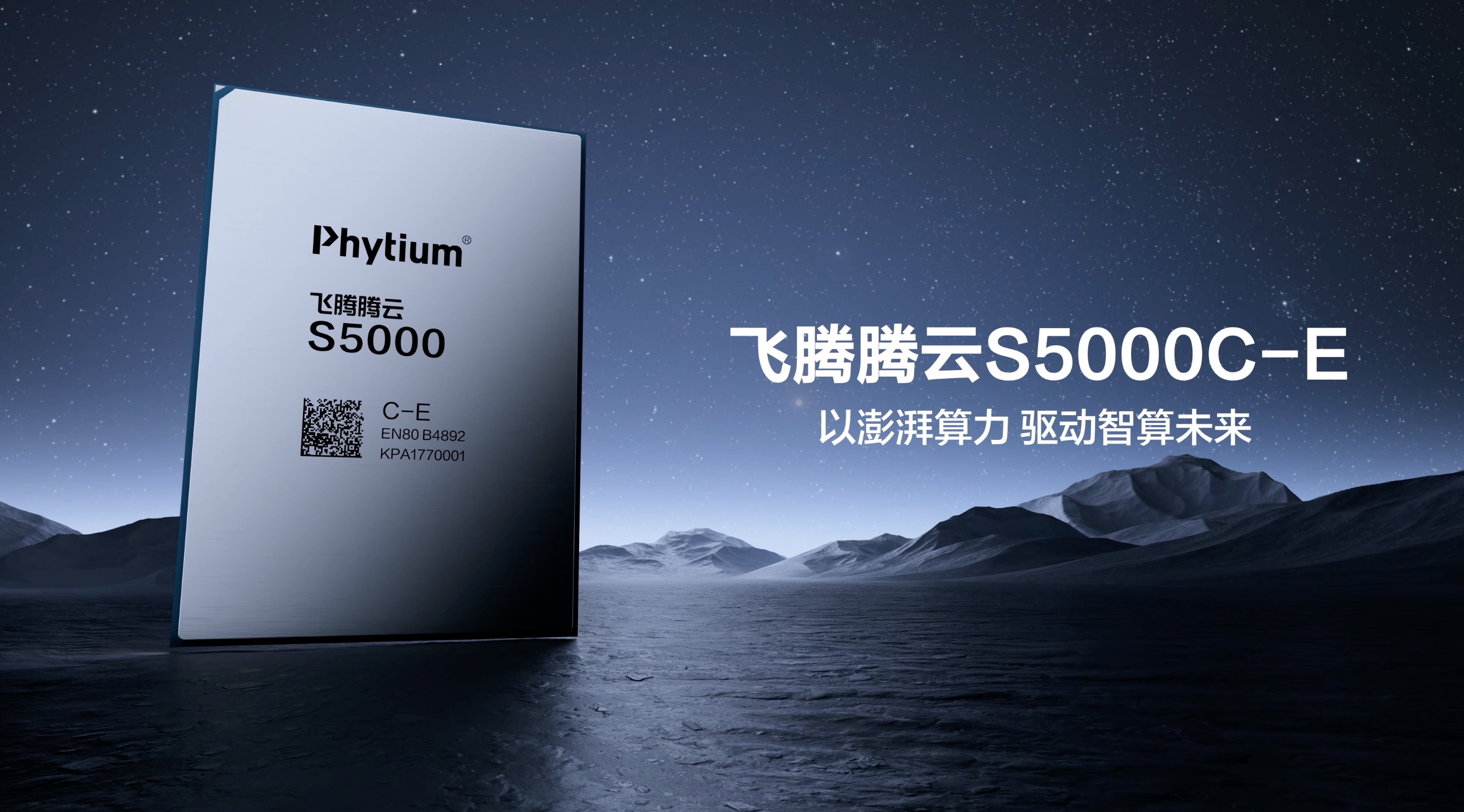
Designed specifically for high-density computing scenarios such as cloud computing, big data, and virtualization, the product has passed the Level II Security and Reliability Assessment by the China Information Technology Security Evaluation Center and was included in the Recommended Catalog of Scientific and Technological Innovations for Central Enterprises (2024 Edition).
This signifies that domestic CPUs now possess the fundamental capabilities required to support large-scale cloud platforms.
Layer 2: China Great Wall for Hardware Hosting
The China Greatwall RF6260 V5 server, equipped with the Phytium Tengyun S5000C-E, utilizes domestic firmware and operating systems to ensure high security and reliability.
During testing, China Great Wall's dedicated team collaborated deeply with CTyun and Phytium to optimize for high-concurrency scenarios. Key enhancements were made to overall stability, hardware compatibility, and sustained full-load operation. This step was absolutely critical.
Cloud platform performance is never just about chip performance; stable hosting capability equally determines the final score.
Layer 3: CTyunOS for System Scheduling
The operating system dictates whether resources can be organized efficiently.
Through modular design, intelligent scheduling, and elastic orchestration, CTyunOS is deeply adapted to Phytium CPUs. Multi-core computing power, high-throughput capabilities, and resource scheduling efficiency are fully unleashed at this layer.
The operating system is often the most overlooked layer in the domestic computing ecosystem. Yet, truly large-scale cloud platforms cannot function without robust underlying resource management.
Layer 4: TeleCloudOS for Cloud Platform Synergy
CTyun's TeleCloudOS features full-chain optimizations specifically for the Phytium Tengyun S5000C-E, with deep adaptation of critical parameters including CPU, memory, and I/O.
At the virtualization layer, TeleCloudOS has successfully adapted QEMU-KVM components for Phytium CPUs. Core functions such as live migration, cold migration, full-machine snapshots, and full-machine backups have all been validated. Even under extreme failure scenarios like host reboots, network disconnections, or power outages, cloud instances can automatically evacuate and recover via HA mechanisms, ensuring business continuity.
Ultimately, all these capabilities converge at the cloud platform.
The cloud platform is responsible for unified scheduling of underlying resources. It determines how computing power is allocated, how resources are orchestrated, how virtualization operates, and how high-concurrency tasks are stably scheduled.
This forms a vertical synergy system of "Domestic CPU + Domestic Server + Domestic OS + Domestic Cloud Platform," which is the most critical reason for this SPEC triumph.
The AI Era: Computing Competition Enters the System Synergy Phase
This global No. 1 ranking sends an even more significant signal.
In the AI era, the nature of computing competition is evolving. While the industry previously focused on single-chip performance, AI training, inference, Agents, and multi-model collaboration are rapidly increasing system complexity.
Single-point capabilities can no longer dictate ultimate performance. The true ceiling is determined by system synergy. Chips, servers, operating systems, cloud platforms, and scheduling systems must work in unison. Domestic computing power is transitioning from "single-point breakthroughs" to "ecosystem synergy."
Currently, the Phytium Tengyun S5000C series processors have been deployed in over 10,000 servers at leading clients, including banks and central state-owned enterprises. Both the Phytium Tengyun S2500 and S5000C have also been shortlisted for China Telecom's server centralized procurement.
The collaboration is now continuously expanding into AI scenarios.
The 4U 8-card AI training and inference integrated machine, built on the Phytium Tengyun S5000C-E, is now compatible with multiple mainstream AI accelerator cards, providing computing support for scenarios like financial large model training.
Moving forward, both parties will continue to advance collaborative solutions in 70B model inference, edge AI inference, and graphics rendering. From general computing to intelligent computing, and from single-point adaptation to full-stack synergy, domestic computing power is entering a brand-new phase.
This global No. 1 in SPEC proves that domestic CPUs, servers, operating systems, and cloud platforms can now form genuine system synergy in authoritative international cloud computing tests.
"National Cloud" and "National Chip" are jointly building an independent computing power ecosystem that truly belongs to China.